Advanced IVF, IUI & ICSI treatments with highest success rates — compassionate care for every step of your fertility journey.
State-of-the-art IVF lab, experienced embryologists and personalised protocols for the best possible outcomes.
Comprehensive care across pregnancy, fertility and advanced gynaecology — delivered with privacy, safety and compassion.
15+ years of expertise, advanced labs and personalised treatment plans.
Advanced facial & body cosmetic procedures by expert surgeons — natural results, minimal downtime, maximum confidence.
Board-certified surgeons delivering natural, beautiful results with the latest techniques.
Expert reconstructive & plastic surgery for hand, birth deformities, cancer reconstruction and trauma — restoring form and function with precision.
Advanced body contouring, breast surgeries & intimate procedures by expert surgeons — natural results, renewed confidence.
Advanced laser skin treatments, intimate wellness procedures & expert hair restoration — all under one roof.
State-of-the-art laser tech & hair restoration by certified specialists.
Comprehensive fertility, hormonal & genetic diagnostics for females and males — accurate, fast and confidential.
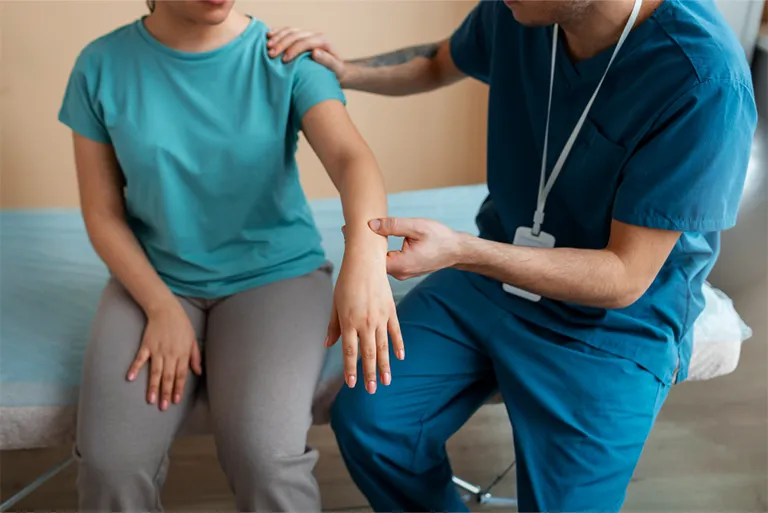
Peripheral nerve surgery treats nerve injuries that cause numbness, weakness, pain, tingling or loss of hand and limb function.
At Galwa Care Hospital, assessment focuses on injury level, nerve continuity, muscle function and timing before planning repair, grafting or decompression.
Specialist nerve care helps improve recovery potential, protect function and guide rehabilitation after injury.
Our team begins every peripheral nerve case with a comprehensive assessment that combines detailed clinical examination with nerve conduction studies and electromyography to establish the exact nature and location of the injury and determine the most appropriate surgical approach. Nerve injuries are stratified according to their severity, and the assessment determines whether the nerve is likely to recover on its own with time, or whether surgical intervention is required to bridge a gap, release compression, or transfer function. The surgical plan is selected from the full range of available approaches, including direct repair, grafting, decompression, and nerve transfer, based on what will give the individual patient the best functional outcome.
At Galwa Care Hospital, nerve repair surgery is performed using microsurgical techniques that allow the surgical team to work with nerves of very small diameter under magnification, ensuring the most precise and reliable repair possible. Post-operative rehabilitation begins promptly and is carefully structured, with physiotherapy protecting joints, maintaining muscle health during the period of nerve regeneration, and progressively retraining movement as nerve recovery develops. We provide honest, regular follow-up with objective assessment of recovery at each stage, adapting the rehabilitation plan as function returns and addressing any complications or secondary procedures promptly.


Surgery is recommended when a nerve has been cut and requires direct repair or grafting, when a nerve is severely compressed and not recovering with non-surgical management, or when nerve transfer is needed to restore essential function that cannot recover naturally. Common causes of peripheral nerve damage include sharp or crush trauma, traction injuries, sustained compression from surrounding structures, fracture-related nerve injury, and surgical complications. The decision to operate is based on clinical assessment, nerve conduction studies, and the duration and severity of the nerve deficit.
The main types of peripheral nerve surgery include direct nerve repair for clean cut injuries, nerve grafting to bridge gaps between nerve ends, decompression for compressed nerves, and nerve transfer to redirect function from a working nerve to a paralysed one. Recovery from nerve surgery is a gradual, long-term process because nerves regenerate slowly at approximately one millimetre per day. Depending on the length of nerve that needs to regenerate and the distance from the repair to the target muscle or sensory area, meaningful functional recovery may take months to more than a year.
The degree of functional recovery depends on the type and severity of the injury, the patient's age, how quickly treatment was initiated, and the length and quality of the nerve repair. In general, younger patients recover nerve function better than older ones, and injuries treated early produce better results than those managed after a long delay. While the goal of nerve surgery is always to achieve maximum possible recovery, it is important to understand that complete restoration of pre-injury function is not always achievable, particularly in severe or longstanding injuries. Honest discussion of realistic expectations is always part of the planning process at Galwa Care Hospital.
Physiotherapy and occupational therapy are essential after peripheral nerve surgery. During the recovery period while the nerve is regenerating, physiotherapy protects the joints from stiffness, prevents muscle shortening, and prepares the limb for the return of function. As nerve recovery progresses, therapy retrains the muscles and helps the patient re-learn movements and sensations. If nerve damage is left untreated, the affected muscles can waste and atrophy permanently, joints can become stiff and contracted, and the sensory loss can become irreversible. Early surgical intervention consistently produces better outcomes than delayed treatment.
Many peripheral nerve procedures use refined, tissue-sparing techniques with incisions placed carefully to access the nerve with minimal disruption to surrounding structures. The procedures are performed under appropriate anaesthesia with post-operative discomfort that is generally manageable with standard pain relief. Patients are typically discharged the same day or after a short hospital stay depending on the extent of the surgery. The recovery period varies widely depending on the procedure, from a few weeks for simple decompression to many months for major nerve repair or transfer cases, with structured follow-up throughout.